|
The World Rally Championship is the most exciting racing I've ever seen. It takes place all over the world, from Sweden to Australia. Each race is made up of three legs, each covering about 400
Km, with numerous stages in each leg. The race spans three days, one leg per day. The cars do not all start at the same time, but are separated by time intervals. The winners of these races are
determined by whoever has finished the entire race in the least amount of time. The drivers must be exceptionally talented as they must race on various surfaces, and conditions. Unfortunately
these races do not appear too often on TV, when they do it is usually ESPN2 or Speedvision.
 
| Here are some examples of locations, lengths, and surface types; |
| Indonesia |
1,127 Km |
dirt/mud some gravel |
| Acropolis |
1,259 Km |
hard pack, gravel (large sharp rocks) |
| Argentina |
1,162 Km |
Gravel, Hard pack, sand |
| Catalunya |
1,359 Km |
Asphalt |
| Sweden |
|
Ice and wet gravel |
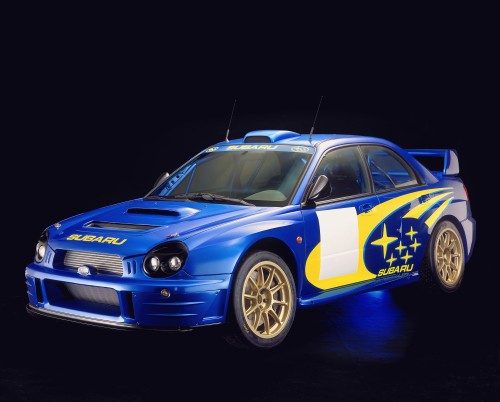
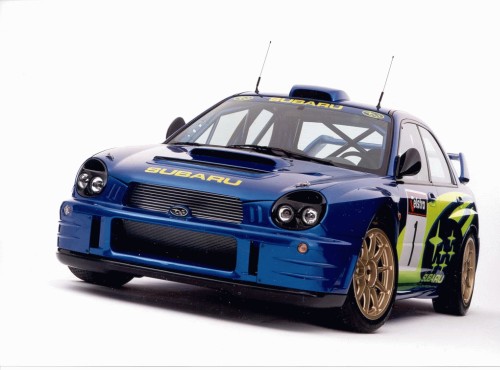
The cars used for these rallies look very similar to cars you would find on the street, Subaru Impreza, Toyota Celica, Ford Escort Cosworth, Mitsubishi Lancer, etc. These cars have 2-litre
turbo-charged engines, 4 wheel-drive, 1230 kg minimum weight, and must be a mid-sized family car. Inside the new World Rally Cars is new instrumentation for both the driver and co-driver. Using
a full colour, high-resolution screen, a new digital dash, capable of displaying 18 pages of information, has been created. Although the cars look very similar to production cars, their bodies
and suspensions have undergone modifications to increase road handling capabilities and performance. For example here are some of the stats for the Team Subaru 555 car:
| Engine: |
Flat 4-cylinder |
| Capacity: |
1994cc |
| Bore: |
92.0mm |
| Stroke: |
75.0mm |
| Engine Management: |
Subaru programmable electronic engine management system |
| Power: |
300bhp/5500rpm |
| Torque: |
48kg-m/4000rpm |
| Drive System: |
4 wheel-drive |
| Transmission (SportShift): |
Prodrive 6-speed manual/semi automatic |
Electro-hydraulically controlled differentials |
| Torque split front/rear: |
50/50 |
| Suspension: |
Front: |
MacPherson strut |
| Rear: |
MacPherson strut with longitudinal and transverse link |
| Side Impact Protection: |
Carbon fibre aluminum honeycomb |
| Brakes: |
Ventilated discs and 4-pot calipers (water-cooled for asphalt) |
| Catalytic Converter: |
Three-way metallic catalyst |
| Steering: |
Power assisted rack and pinion |
| Dimensions: |
Overall length: |
4340mm |
| Overall width: |
1770mm |
| Overall height: |
1390mm |
| Wheelbase: |
2520mm |
| Car weight: |
1230kgs |
| Data Logging ECU: |
3 microprocessor controllers linked by a canbus programmable colour display (driver) |
| Tyres: |
Pirelli |
| Shock Absorbers: |
Bilstein |
| Radio Equipment: |
Kenwood |
| Turbo Charger: |
IHI |
| Spark Plugs: |
NGK |
| Wheels: |
Speedline |
|
Provisional Calendar for 1998 |
| Monte Carlo (Jan 18 - 21) |
Sweden (Feb 6 - 8) |
| Safari (Feb 27 - Mar 2) |
Portugal (Mar 23 - 25) |
| Catalunya (Apr 20 - 22) |
Corsica (May 4 - 6) |
| Argentina (May 21 - 23) |
Acropolis (Jun 7 - 9) |
| New Zealand (Jul 26 - 28) |
Finland (Aug 21 - 23) |
| Indonesia (Sep 18 - 20) |
San Remo (Oct 12 -14) |
| Australia (Nov 6 - 8) |
RAC (Nov 21 - 24) |
| New Zealand and Finland will most likely be moved to one week later times |
|